Racking Systems used for warehouse storage
This post explores the various racking systems used in warehouses for storage of goods. Racking systems explored in this post are as followed:
▪ Selective Racks
▪ Cantilever Racks
▪ Drive-In Racks
▪ Drive-Through Racks
▪ Push-Back Racks
Selective Racks

Selective racks are commonly used by warehouse for storage of their goods. These type of racks allow direct access to all stored pallets and the advantage of handling one pallet without the need to move the others.
Narrow Aisle Selective Racking
A "Narrow Aisle" layout, utilizing specialized reach lift trucks can reduce aisles, typically by about 25%.
Very Narrow Aisle Selective Racking
A further approximately 15% can be saved, with a "Very Narrow Aisle" (VNA) layout, utilizing specialized "swing reach" or "turret" trucks. VNA layouts are ideal for where space is very expensive (e.g. temperature controlled environments).

 Cantilever Racks
Cantilever racks are the most cost effective use of space for storing large bulky items that are longer than a pallet, such as PVC pipes, furniture and lumber. These hard-to-store materials are into an orderly storage system where they are more accessible and easier to track. Product and inventory control becomes easily accessible for hand or forklift loading and retrieval. Stored items are presented in a highly visible manner, expediting inventory control.
Drive-In Racks

Drive-in racks allow a forklift to enter the rack from one side to pick up or retrieve pallets. This is possible as pallets can slide backwards on a continuous rail. The forklifts are able to drive into the rack to access pallets two or more deep. The depth of storage is limited by the size of the warehouse. Drive-In racks are subjected to more abuse than selective racks due to the way they are utilized, so rack integrity and strength are important factors. This rack system allows "Last-In, First-Out" storage and is ideal rack for cooler or freezer applications.
Drive-Through Racks
Drive-through racks allow a forklift to enter the rack from either side to pick up or retrieve pallets. Loads are supported by rails attached to upright frames, and forklifts are driven between uprights to reach pallets. This is done because pallets can slide backwards on a continuous rail. It's open at both ends, allowing "First-In, First-Out" storage.
Drive-through racks also offer the ability to store a large amount of similar loads in a smaller area. Selectivity is sacrificed, but storage density is enhanced since many pallets are stored and are available through a single pallet position.
 Push-Back Racks
In push-back racks, pallets are fed and retrieved from one aisle, reducing picking times and making these racks ideal for applications that require a large number of picking faces.
Three and four pallets deep systems are common, which allows blocks of 6 or 8 deep, with back to back rows. This system has improved selectivity over drive-in. Forklifts do not need to be driven into rack loads come to them at the pick face. As the forklifts do not drive into the racks, as opposed to the drive-in rack system, less products on the rack is damaged. When comparing a three deep, back to back push-back system to a single selective rack system, the push-back system will amount to a space savings of 40%.
Labels: LSCM
Postponement strategies enable companies to design products that are customized and assembled quickly and inexpensively once actual customer demand is known, as opposed to building products in bulk and storing them in warehouses until demand increases.
A study on postponement strategies has been done by Oracle, APICS, and Cap Gemini Ernst & Young. This study has found that postponement strategies have reduced demand uncertainty and improving customer satisfaction. The study also recognizes the following as the top inhibitors to successful postponement strategies implementation:
• Inability to recognize where postponement is most effective
• Inability to quantify benefits
• Belief that technology does not support implementation
The study identifies companies that are in the strongest position to employ successful postponement strategies will have strong support from senior management. They will be using integrated, Web-based enterprise business solutions that facilitate and support collaboration and visibility across the extended supply chain. They will also adopt standardized and automated business processes to support faster response times and real-time intelligence.
Postponement is most effective when companies have implemented strategic sourcing and formal buying strategies, such as vendor-managed inventory (VMI) or consignment, to reduce financial risk, supply variability and lead times. At the heart of postponement is a company's ability to maintain competitive service and delivery performance levels.
Labels: LSCM
In order to overcome the disadvantages of push/pull systems and take advantage of the benefits of both systems, some companies adopted hybrid push-pull systems. Curious about some of these hybrid systems, I have researched and found some examples.
One example is on the Lean Supply Chain Strategy. Lean focuses on the elimination of waste with a bias towards “pulling” goods through the system based on demand. Lean is an approach that “identifies the value inherent in specific products, identifies the value stream for each product, supports the flow of value, lets the customer pull value from the producer, and pursues perfection. It is through this holistic, enterprise-wide approach to lean implementation that the theory extends beyond functional strategy to a broader supply chain strategy employed by the company.”
Despite the focus on pull, however, the authors note lean is really a make-to-stock system, reacting to “demand signals” that typically come from forecasts or next tier distributors, rather than actual orders (e.g. Toyota). The demand horizons are typically shorter than non-Lean systems, but the overall supply chain still relies on finished goods inventory.
Labels: LSCM
Job shops are small manufacturing operations used for handling specialised manufacturing processes such as a single order or small batch jobs. Job shops usually move on to other jobs from different customers after completion of each job.
Problems regarding the use of job shop manufacturing are high direct labour cost involved, high quality variation due to design inconsistencies and high raw material costs due to low volume needs. Some industries using job shops are the aerospace and construction industries.
Assembly lines, in comparison to job shops, are a faster and more cost effective way of production. Assembly lines are often used to mass produce products such as automobiles, textile and food industries.
Labels: LSCM
During this lecture, Mr Koh mentioned about factory physics. Factory physics refers to a systematic description of the laws that govern factory operations.
I have found that reducing work-in-process inventory in order to free up the funds represented by the inventory is something desirable. A simple factory physics relationship about work-in-process inventory is that
where work-in-process inventory refers to the number of unfinished parts in production, throughput refers to the amount of finished product manufactured in a given time period and cycle time, the amount of time a product spends in the factory from start to finish. From the simple equation, to reduce average work-in-process inventory and keep throughput the same, we need to keep the cycle time low.
Bill of Materials is a formula for making a product. An example of a Bill of Materials can be seen below.
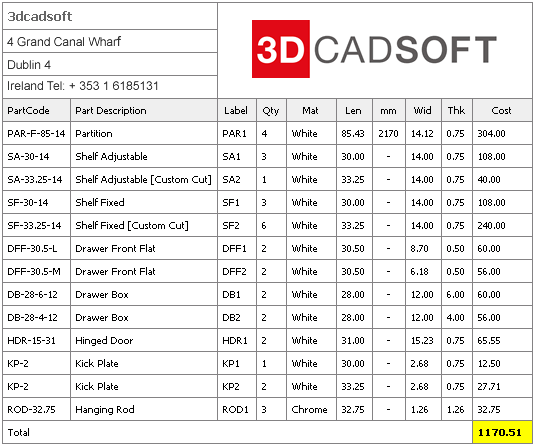 Figure 1: Example of a Bill of Materials
Labels: LSCM
After reading the article about ElectroParts Pte Ltd, I think that their current sourcing strategies of using global sourcing and usage of the Internet are good in a sense that the strategies enables them to have access to a wide supplier base and to find 'wanted' products fast and accurately. However, as a result of global sourcing, ElectroParts need to take into consideration the increased lead time and shipping costs as their suppliers are located around the globe.
I think that EletroParts' practice of using Order Point Order Quantity (OPOQ) for the fast moving products is a good idea as OPOQ is able to calculate and replenish the stock to a safe level if stock level falls below a certain point. However, I think that the practice of forecasting quarterly customer demands should be replaced by Vendor Managed Inventory (VMI) so as to see the actual customer demand and to overcome the bull-whip effect.
EletroParts' practice of shipping in bulk, although may lower transportation costs and the cost of a unit of each product, may result in the need for more storage space and cost and the problem of having excess inventory.
Labels: LSCM
During this lecture, it is introduced that "sharing of information among members of the supply chain also helps to reduce the bullwhip effect". What is bullwhip effect? What are the problems it can cause? It is a phenomenon in forecast-driven distribution channels. Customer demand is always changing, therefore businesses must forecast demand in order to properly position inventory and other resources. Forecasts are based on statistics and they are rarely perfectly accurate. As forecasts are not accurate, companies often carry an inventory buffer called "safety stock". Moving up the supply chain from end-consumer to raw materials supplier, each supply chain participant has greater observed variation in demand and greater need for safety stock.
 One example is shown in the figure above (Figure 1: Bullwhip effect). In periods of rising demand, down-stream participants will increase their orders. In periods of falling demand, orders will fall or stop in order to reduce inventory. The effect is that variations are amplified the farther you get from the end-consumer.
This unplanned for demand results in a disturbance in supply, which may be a minor blip for any one customer, oscillates back through the supply chain often resulting in huge and costly disturbances at the supplier end of the chain. Often, these demand fluctuation will launch a mad scramble in manufacturing with the need to acquire more raw materials and reschedule production. Other problems of the bullwhip effect includes excess inventories, quality problems, higher raw material costs, overtime expenses and shipping costs.
Some casues of the bullwhip effect are forecast errors, price fluctuations, product promotions, delay times for information and materials and no communication and coordination up and down the supply chain.
Some solutions to overcome the bullwhip effect are to move from a forecast-dependent system that lacks actual demand visibility to Just In Time (JIT) replenishment or Vendor Managed Inventory (VMI) which can provide data about customer demand. Price fluctuations and product promotions can be prevented by using special purchase contracts to specify ordering at regular intervals to better plan delivery and purchase.
Labels: LSCM
In week 2's lecture, Mr. Koh introduced a couple of new terms: reverse auction and Analytical Hierarchy Process (AHP). After some research, I have managed to find out what those terms mean.
Reverse auction is often used in industrial business-to-business procurement. Traditional auction works by having one seller to many buyers, driving the cost of the goods/service up as buyers compete to obtain the goods/service. Reverse auction works in the exact opposite way, by having many sellers to one buyer. This drives the cost of the goods/service down as sellers compete to offer the best price to the buyer.
However, there are issues regarding reverse auctions. While buyers may cut cost by using reverse auctions, sellers lose revenue as they are pressurized to push the selling price of their goods/service lower. Overusing of reverse auctions can erode the relationship between buyers and sellers. It also must be noted that reverse auction does not deliver cost savings in every case. Direct and indirect losses associated with using reverse actions, implementing reverse auction results, subsequent procurement activity, and related activities (such as customer returns, defective goods or services, etc) should be calculated to see whether reverse auction is cost-saving or otherwise. In conclusion, reverse auction should only be used when appropriate.
Analytical Hierarchy Process (AHP) is a method for formalizing decision making where there are a limited number of choices but each has a number of attributes and it is difficult to formalize some of those attributes. It uses the human ability to compare single properties of alternatives. It not only helps decision makers choose the best alternative, but also provides a clear rationale for the choice made.
Labels: LSCM
First day on LSCM tutorial... First day on this blogging stuff... Some of you out there might be wondering what is LSCM. Well.. it stands for Logistics and Supply Chain Management. The purpose of this blogsite is to showcase what is LSCM. There are two reason to why i chose this subject. First reason is quite obvious: to pass this subject > to get enough credits > to get out of school > to get on with life.
The second reason is more on interest. I have worked at a small 3rd party warehouse (Globalware Solutions) down at Changi South. Pretty nice place to work in... Though a little too warm for comfort at times. Good music all day long and nice people to hang around with there. We handle a range of goods from books to display items from AMD to Cramplers from Michelin! But sometimes I wonder.. How these goods come around? Where these goods go to after shipping out? This sense of curiosity spark my interest in LSCM.
Anyway... Hope that I will be so hardworking as to update this blog once in a awhile. Until then...
Labels: LSCM